
CIO market update for April 2025
In this CIO market update, we unpack a volatile April shaped by Trump’s tariff twists, weakening US sentiment, and market uncertainty. Despite global turbulence, Australia remains comparatively well-positioned, with the RBA retaining flexibility as inflation trends lower.

Jump to ⏬: USA | New Zealand | China | Australia | Outlook
President Trump’s announcements regarding tariffs were again key to global market movements during the month. The unpredictability of policy pronouncements (and their subsequent change) is causing markets to thrash about from day to day.
All global markets continued to be buffeted by President Trump’s announcements regarding tariffs during April. Trump’s April 2 “Liberation Day” announcements proved to be significantly larger than investors had been expecting and led to a sharp downturn in equity markets and bond yields across the globe early in the month. A week following the Liberation Day announcements, a sharp deterioration in the US bond market (where yields rapidly rose by nearly 0.5% over a single trading session) seems to have caused the President to announce his pause on tariff implementation. From this point, equity markets gradually recovered, and global yields retreated from mid-month highs.
Amidst all the volatility, some trends were clearer than others over the month:
- Shorter-term yields in most global markets fell significantly – by 0.3% to 0.4% – as yield curves “bull-steepened”, with investors ending the month expecting significantly more central bank rate cuts than had been expected at the end of March
- The USD fell by 4.4% (on a trade-weighted basis)
- US and European equities ended lower, whereas the Australian equity market ended higher
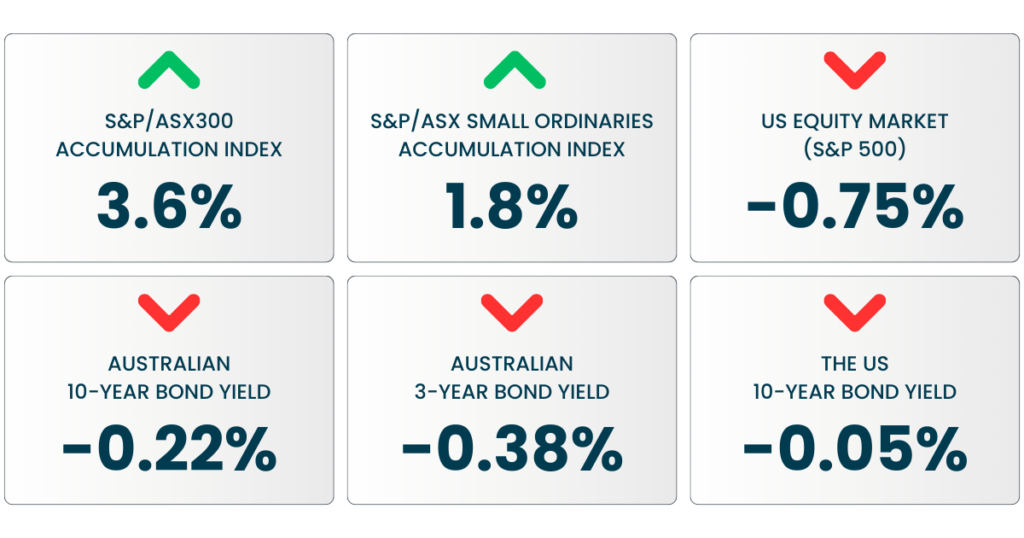
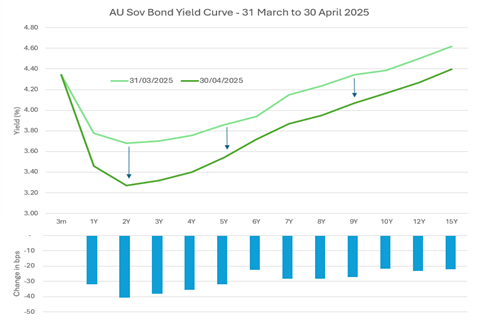
Over the full month, US 10-year bond yields slipped by 0.05%, ending at 4.16%, while 2-year yields fell by 0.28% to end at 3.60%. Australian 10-year yields fell 0.22% to 4.17%, while 3-year yields collapsed by 0.38% to close the month at 3.32%.
The Australian dollar finished the month higher at USD 0.6402, a move primarily reflecting weakness in the USD.
Key market movements over the month:
In this CIO market update, we look at:
- Market questioning of the USD’s role as a hedge during times of market stress
- Trump’s comments about Fed Chair Powell
- Is tariff uncertainty impacting the US economy? Sentiment has clearly been impacted, but will this downturn in sentiment lead to weaker economic activity? (this seems increasingly likely)
- The US March quarter GDP contraction distorted by the front-loading of imports ahead of the tariffs
- US consumer and corporate sentiment deteriorating sharply
- Reserve Bank of NZ cuts rates – citing tariff uncertainty
- Potential tariff impact on China
- Australia seems to have more policy flexibility than most countries to enable authorities here to respond to what may unfold
We noted two months ago that our previously held cautious optimism about the market outlook had been downgraded, with us becoming more cautious owing to the risks and uncertainties surrounding the new US administration’s policy announcements. Unfortunately, these announcements have not only laid out the prospect of larger-than-anticipated tariff increases but have also been extremely volatile, with some being “walked back” in the days following their initial announcement.
Other policy announcements by the new US Administration have proved similarly volatile, including, in particular, Trump’s April 21 comment that he regarded Fed Chair Powell as a “major loser” and called on him to lower rates “NOW.” These comments were later partially retracted.
The nature of these comments and their randomness are clearly causing global investors to question their holdings of US assets, which probably explains the USD’s weakness during the month.
Against this background of global uncertainty, we feel the Australian economy is better placed than many other economies to withstand the expected negative influence of global tariff developments:
- Australia’s exports to the US are a very small proportion of the overall economy
- Australia’s starting point of high cash rates means the RBA has significant room to move rates lower if required
- Fiscal support of the economy is likely to continue to have a positive influence
So, while we maintain our cautious stance due to the global backdrop, we feel Australia will fare better than most other economies and markets during this highly uncertain period.
• USA •
The role of the USD as a hedge to global volatility and growth risks now being questioned
The past month has witnessed tremendous volatility in asset prices, with the US at the heart of the action – the USD has weakened against a background of rising market volatility and deteriorating investor sentiment. This kind of price action is highly unusual given the USD’s typical role as a key reserve currency that usually appreciates when asset markets are volatile. Indeed, as the ultimate safe asset underpinning USD, US Treasury yields are not supposed to rise by 50bp over the course of a week (as they did mid-month), even as 10-year German and Swiss yields were flat.
If the source of uncertainty and volatility, whether relating to global security or trade policy, is perceived to be the policy decisions of the US government itself, then it is possible that investors have made a conscious decision to scale down their allocations to US assets and to increase hedging of those assets. Asset market performances seem to suggest that foreign investors now want a higher risk premium to hold US assets or a weaker USD first before adding to USD positions.
Trump calls Fed Chair Powell a “major loser”, calling on him to lower rates NOW
As well as tariff uncertainty, Trump’s comments regarding key institutions in the US – such as the US Federal Reserve Board and its leadership – are also making investors increasingly unsettled. Witness Easter Monday (April 21), when President Trump referred to Chair Powell by stating that “there is virtually no inflation” but “there can be SLOWING of the economy unless Mr. Too Late, a major loser, lowers interest rates, NOW.”
It’s still too early to tell if the tariff uncertainty has directly impacted the US economy, but it near certainly will
In trying to judge how significant the impact of the tariff uncertainty will be on the US economy, we need to turn first to surveys of sentiment and confidence across the US corporate and household sectors. These surveys contain forward-looking elements but are not a failsafe guide as to how the “real” economy will perform in the future, although it seems most likely that the sharp decline in these surveys is extremely likely to lead to broader economic weakness.
Regional Fed district economic surveys are pointing to sharply declining confidence, which will likely translate to weaker underlying economic growth
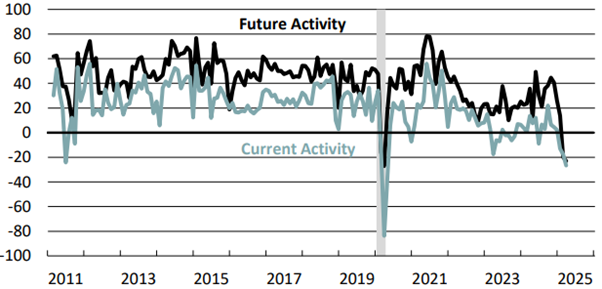
Each Federal Reserve district in the US produces a range of economic surveys designed to assess business sentiment in their own regional area. The pattern revealed in the latest April Philadelphia Fed’s Non-Manufacturing Business Outlook Survey is typical of many. This survey fell further in April, with responses suggesting that continued declines in non-manufacturing activity are expected in the region over the next six months. Leading components of the survey, such as new orders, remain negative. Surveys such as this and other corporate surveys are nearly unanimous in highlighting the significant uncertainty caused by the tariff announcements, which seems to already impact order flows across US businesses.
Philly Fed Non-Manufacturing Business Outlook Survey – Current and Future General Activity
Source: April Philadelphia Fed’s Non-Manufacturing Business Outlook Survey
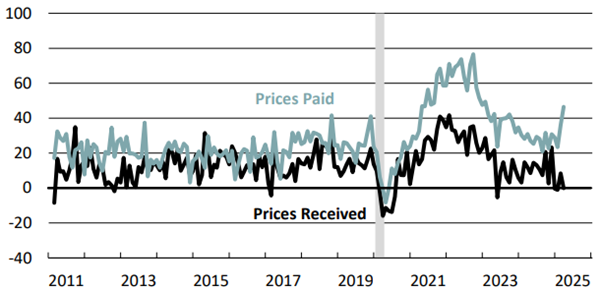
While the weakening outlook for economic activity suggested by this survey would generally be expected to lead to official interest rate cuts, complicating the outlook for the Fed are price indicator readings that suggest continued increases in input prices, likely as a consequence of the expected impact of tariff increases. This makes the Fed’s job more difficult.
Philly Fed Non-Manufacturing Business Outlook Survey – Current Prices Paid and Received
Source: April Philadelphia Fed’s Non-Manufacturing Business Outlook Survey
US consumer sentiment and inflation expectations significantly impacted by tariff news
Unsurprisingly, according to the University of Michigan’s monthly survey, consumer sentiment fell in April for the fourth straight month, declining 8% from March.
While the April decline in current conditions was modest, the expectations index plummeted with drop-offs in personal finances and business conditions. Expectations have fallen a precipitous 32% since January, the steepest three-month percentage decline seen since the 1990 recession.
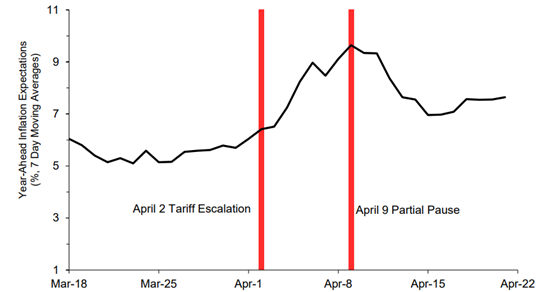
US consumer inflation expectations evolve with tariff news
Source: University of Michigan
According to the survey, year-ahead inflation expectations surged from 5.0% in March to 6.5% in April, the highest reading since 1981. This marks four consecutive months of unusually large increases of 0.5 percentage points or more.
As can be seen in the chart above, inflation expectations evolved with major trade policy announcements during April. After the 9 April partial pause in tariff increases, inflation expectations ebbed but remained substantially elevated relative to March.
US Leading Index falls sharply in March – tariff uncertainty taking a toll
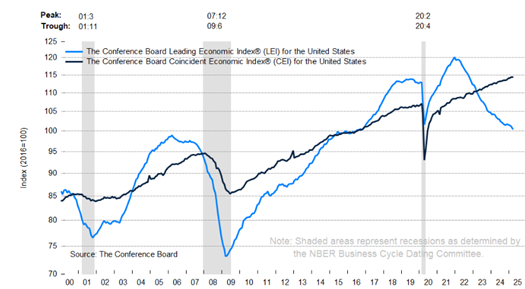
The Conference Board’s Leading Economic Index (LEI) declined by 0.7% in March after retreating by 0.2% in February. According to the survey’s authors, “the LEI… pointed to slowing economic activity ahead.” Key to the weakness was “soaring economic uncertainty ahead of pending tariff announcements.” The Leading Index has now deteriorated for four consecutive months since President Trump’s inauguration, with the fall in March the largest single-month drop since October 2023.
While saying that the data does not suggest that a recession has begun or is about to start, the Conference Board downwardly revised their outlook for US economic growth in 2025, noting that “the slower projected growth rate reflects the impact of deepening trade wars, which may result in higher inflation, supply chain disruptions, less investing and spending, and a weaker labor market.”
US Leading Economic Indicator
Source: US Conference Board
The US economy did contract in the March quarter, but this was mainly due to a “bring-forward” of imports ahead of the tariffs
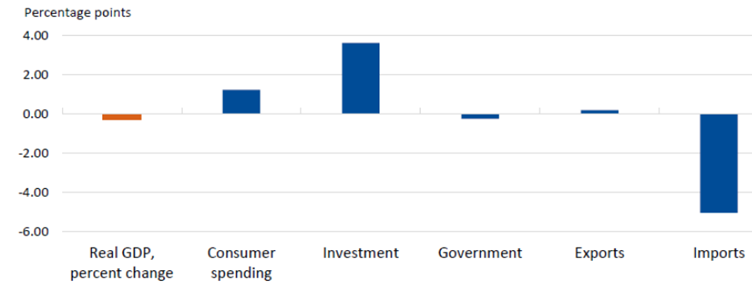
The US economy contracted slightly (-0.3% annualised) in the March quarter. While this may seem to be a clear sign of the impact of tariff uncertainty on the economy, it was, in fact, the bringing forward of imports (which contribute negatively to the GDP calculation) that was overwhelmingly responsible for this weakness (Imports are a subtraction from the calculation of GDP, therefore, an increase in imports results in a negative contribution to GDP). However, it is also very likely that the growth in private consumption recorded in the quarter (which contributed positively to GDP) may have been boosted similarly by consumers bringing forward their purchases.
Contributions to US March Quarter Gross Domestic Product (GDP)
Source: US Bureau of Economic Analysis
• New Zealand •
Impact of policy uncertainty is spreading across the globe – Reserve Bank of New Zealand (RBNZ) cuts rates and maintains a “dovish” stance in the face of tariff uncertainty
In line with expectations, the RBNZ lowered its official cash rate by 0.25bps to 3.50% in April.
The accompanying statement’s “forward guidance” reiterated a clear easing bias, noting that “as the extent and effect of tariff policies become clearer, the Committee has scope to lower the OCR further as appropriate.” The [Monetary Policy] Committee judged that recently announced tariffs “create downside risks to the outlook for economic activity and inflation.”
On the likely growth impact of tariffs, the Committee noted that “demand for our exports is likely to decrease” while “increased uncertainty around global trade policy will also weigh on investment and spending, as will declines in asset prices.”
• China •
Potential tariff impact on China likely to be partially mitigated by Chinese policy easing
On April 9th, President Trump announced a further increase in the tariff rate on imports from China to 125%, following the Chinese government’s increase of tariffs on US goods to 84%. Although additional tariff increases are likely to have a shrinking marginal impact, the substantial rise in US tariffs on China is expected to significantly weigh on the Chinese economy.
In response to these tariff changes, we expect the Chinese government will further intensify policy easing, likely to include monetary policy rate cuts and spending increases. However, even significant prospective easing measures are unlikely to fully offset the negative effects of the tariffs, with most analysts lowering their growth forecasts for China for 2025
• Australia •
Australia relatively well-placed globally amidst tariff uncertainty
We noted earlier that we feel the Australian economy is better placed than many other economies to withstand the expected negative influence of global tariff developments.
From a more bottom-up perspective, the tariffs will directly impact some specific sectors and companies. At this stage, the most exposed industries will likely include agriculture (meat products), medical and pharmaceutical products (albeit with some exemptions), and some advanced manufacturing products (medical, measurement, aircraft/spacecraft).
It is also important that Australia’s goods exports to the US (excluding gold) represent only around 3.1% of Australia’s total exports (goods and services) and just 0.7% of Australian GDP. Given that Australia is being hit by the baseline tariff of 10% (the lowest of any tariff level), Australia is relatively better off than most and, in some cases, could benefit—Australian products may become more competitive relative to other countries with higher tariff rates.
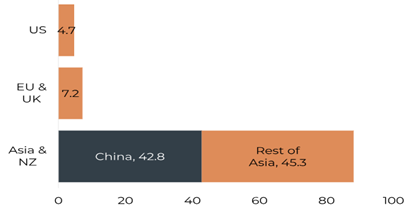
More potential downside risk for Australia probably lies with indirect impacts – how our major trading partners are impacted. Australia’s major trading partners — 88% of goods exports go to our Asian trading partners, including 43% to China — face an effective weighted average tariff rate, with the US at 35%. Reflecting this, our mix of trading partners is more exposed to the tariff announcements than the global average, according to analysts at Barrenjoey.
Australia’s Export Trade Destinations (% four year rolling share of top 11 destinations)
Source: Barrenjoey
According to the Barrenjoey analysis, the effective tariff rate globally is approximately 20%, compared to the 35% rate faced by Australia’s major trading partners. This means Australia is one of the countries disproportionately indirectly exposed to a tariff-driven global trade slowdown.
This indirect trade effect can be larger than the direct effect, given that Australia exports large volumes of raw materials, which are often used to produce goods that are then exported.
On a net basis, though, Australia is still likely to be better off relative to other economies. The direct economic effects of tariffs on the EU, China, Canada, and Mexico are likely to be materially larger than the indirect effects on Australia.
Australia’s starting point metrics are important, too. The key is that Australian monetary policy rates are higher than most other countries, and at 4.10%, rates have significant room to move lower if the deterioration in global conditions is sufficiently severe enough to warrant such a move by the Reserve Bank (RBA). During April, market expectations regarding future policy cuts moved dramatically, as can be seen in the chart below. This may have been a major reason for the Australian equity market being one of the better-performing markets globally.
Source: Bloomberg
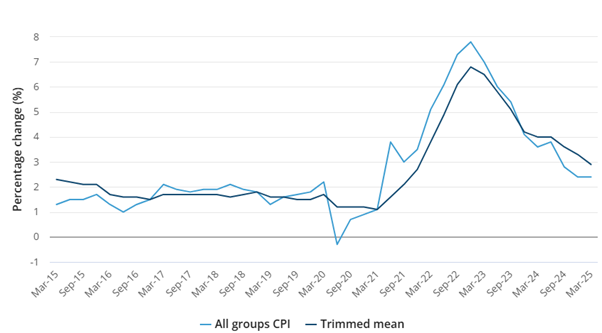
Important in giving the RBA flexibility to cut rates if required is the downward trend in inflation, which, if confirmed by ongoing inflation reports, should continue to give the RBA the policy flexibility to continue lowering rates in meetings this year. The March quarter CPI report continued the trend of gradually easing underlying inflation pressures, as seen in the chart below.
So, while we maintain our cautious stance due to the global backdrop, we feel Australia will probably fare better than most other economies and markets in the near future.
Australian Consumer Price Index
Source: Australian Bureau of Statistics (Mar-quarter-2025), Consumer Price Index, Australia
• CIO market update: Outlook •
Where to from here?
The main issue facing investors is the continued volatility of US policy announcements and any corresponding countermeasures from other countries. Forming a concrete opinion about market direction in the face of such uncertainty is very difficult.
On balance, it seems most likely that the extreme uncertainty created by the on-again/off-again tariff narrative will lead to a significant slowdown in the US economy, with ripple effects across the world. The extent of any slowdown is difficult to judge but will probably be determined by how long the uncertainty continues and the size of the tariffs.
However, it seems that markets are not priced for a significant slowdown in US and global growth. Consequently, any sign that the US was deteriorating with a recession likely would likely lead to further equity market weakness.
The Australian market, having posted a positive month, is not cheap, and while it is relatively well positioned, it is still vulnerable to market shocks. It is increasingly possible that the super-combative stance that Trump was originally espousing is gradually being wound back, which has temporarily settled investors’ nerves. Still, the near-term issue is that the US economy is clearly weakening, which will have implications for earnings. We would not be surprised to see markets again test the lows we saw in April, and therefore, do not feel overly optimistic about the short-term prospects for markets. This sort of volatility, however, is the opportunity for active managers such as ourselves. We continue to look to establish or add to our positions in excellent quality companies that offer a real margin of safety over the long term.
We will continue to provide regular insights in each CIO market update as the global landscape evolves.
Read Rob’s previous macro updates | Back to the top ⏫
Disclaimer:
SG Hiscock & Company has prepared this article for general information purposes only. It does not contain investment recommendations nor provide investment advice. Neither SG Hiscock & Company nor its related entities, directors or officers guarantees the performance of, or the repayment of capital or income invested in the Funds. Past performance is not necessarily indicative of future performance. Professional investment advice can help you determine your tolerance to risk as well as your need to attain a particular return on your investment. We strongly encourage you to obtain detailed professional advice and to read the relevant Product Disclosure Statement and Target Market Determination, if appropriate, in full before making an investment decision.
SG Hiscock & Company publishes information on this platform that to the best of its knowledge is current at the time and is not liable for any direct or indirect losses attributable to omissions for the website, information being out of date, inaccurate, incomplete or deficient in any other way. Investors and their advisers should make their own enquiries before making investment decisions.

Stay in the loop
Get the latest insights and company news direct to your inbox.
SG Hiscock & Company (SGH) has prepared this article for general information purposes only. It does not contain investment recommendations nor provide investment advice. Neither SGH nor its related entities, directors or officers guarantee the performance of the Funds. SGH also doesn’t guarantee the repayment of capital or income invested in the Funds. Past performance is not necessarily indicative of future performance. Professional investment advice can help you determine your risk tolerance as well as your need to attain a particular return on your investment. We strongly encourage you to obtain detailed professional advice. We recommend that you read the relevant Product Disclosure Statement and Target Market Determination, if appropriate, in full before making an investment decision.SGH publishes information on this platform that is, to the best of its knowledge, current at the time of publication. It is not liable for any direct or indirect losses attributable to omissions, outdated, inaccurate, incomplete or deficient information. Investors and their advisers should make their own enquiries before making investment decisions.