
Market update: What on earth is going on?
Market update: Steve Hiscock and Rob Hogg unpack sentiment shocks, tariff turmoil, and why Australia may be better positioned than most.
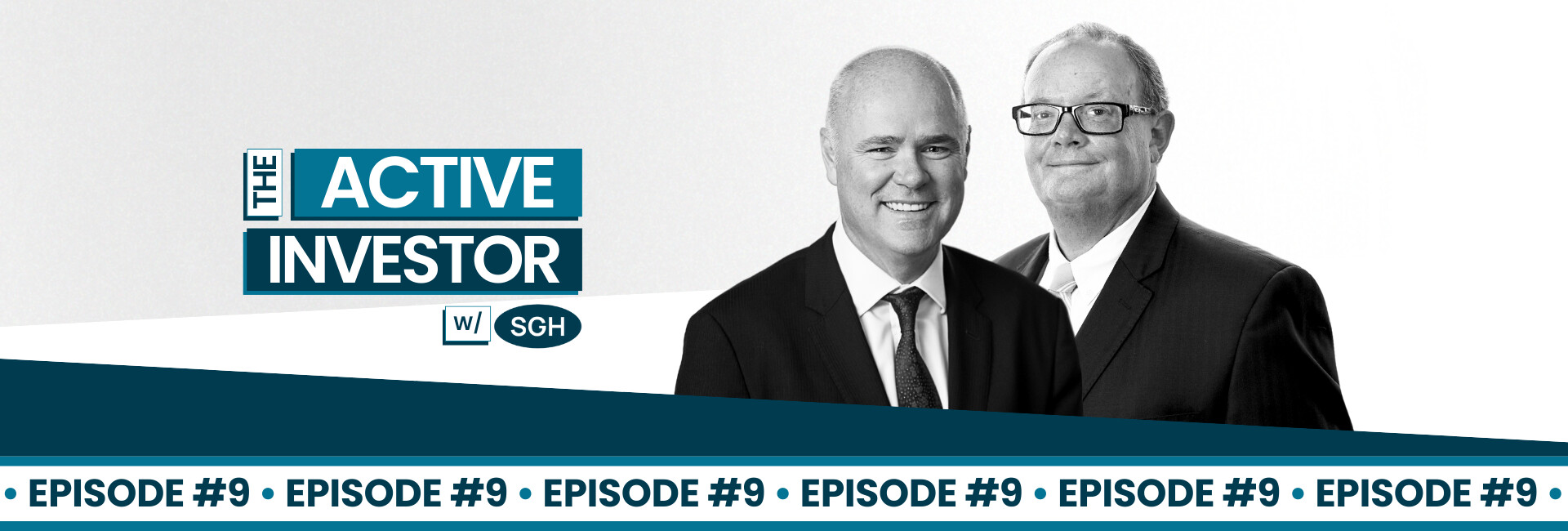
In episode #9 of The Active Investor with SGH – Market update: What on earth is going on?, Steve Hiscock and Rob Hogg unpack the sharp drop in sentiment, market volatility, and what it all means for investors in the wake of escalating US policy uncertainty.
More places to find our podcast:
Market update: What on earth is going on?
Transcript:
Steve Hiscock:
Hello to everyone listening to our podcast, the Active Investor with SGH. I’m Steve Hiscock, the company chair, and it’s my pleasure to be your host for today’s episode. In today’s podcast, we will look at the current extraordinary markets and volatility. Unusually, this is mid-month when we’re talking because so much is happening worldwide. I will be joined again, pleasingly, by our Chief Investment Officer, Rob Hogg. Rob, welcome back again!
Rob Hogg:
Thanks very much, Steve! And yeah, it’s good to catch up mid-month, given there’s been extreme volatility across almost every market now.
Steve Hiscock:
Oh, absolutely. And we’ll get into that. We are recording this podcast on Tuesday, the 15th of April. Rob, let’s talk about what’s been happening, but maybe we could start with the sentiment. Sentiment, well, not just in the US but worldwide, has been plummeting. Can you talk a little bit about that? It’s not just personal, is it? It’s not just consumer sentiment; it’s also corporate sentiment as well.
Rob Hogg:
Yeah, no, that’s right. And look, one of the reasons we look at sentiment is because we’re talking here about surveys of small companies and large corporations in manufacturing and services, as well as surveys of consumers. And the reason we tend to look at them is because they can be forward-looking. They tend to go up and down ahead of movements in the underlying macro data, but they’re not always a fail-safe indicator. But let’s look at some of the extreme movements. We could, for example, look at some of the consumer sentiment surveys in the United States. The University of Michigan produces one of the two key surveys. And their most recent reading for April showed that consumer sentiment fell for the fourth straight month, down 11%, in fact, for the month. And sentiment has now lost 30% since December 2024.
Steve Hiscock:
And I’m sorry, Rob, just to cut across you there, 11% fall in one month.
Rob Hogg:
In one month.
Steve Hiscock:
That’s really unusual, right?
Rob Hogg:
That is very, very significant and very, very unusual. Very, very rare. However, one of the tricky things for policymakers, particularly for the US Central Bank, is that just as confidence is plunging, expectations about inflation have been rising. So, in this same survey for April, a year ahead, consumer inflation expectations surged to 6.7% from 5%, the highest reading since 1981. And talking about significant moves, that is the fourth month of unusually large moves of half a percentage point in expectations. For inflation. One way of thinking about that is in statistics. We talk about whether something is significant. Big moves like this suggest that they are significant and that the US consumer is amid quite a considerable rethink and resetting of their inflation expectations as sentiment is plunging. So, this is shaping up as a dilemma for the US Federal Reserve.
Steve Hiscock:
And the worst of fears, in a way, isn’t it? Because people have been talking about the spectre of stagflation slowing the economy plus inflation, and that’s not good for equity markets. But you are saying that consumer sentiment and other sentiment indicators indicate that the economy will likely slow down. It’s just how much by and at the same time, price expectations are going up. It’s a really bad mix, isn’t it?
Rob Hogg:
It is a very bad mix. So that’s consumers. As you are pointing out, these are very big moves, and they’ve now been going on for several months. So, the probability of spending following – spending moving in the same direction as sentiment – seems to be rising, unfortunately. Let me share what corporates are saying because some of the language is very telling. This is directly from the most recent ISM or corporate sentiment survey for manufacturers in the US. And that was lower, and what were firms saying? – they were saying demand and production retreated, and de-staffing continued as panellists’ companies (companies participating in the survey as panellists) responded to demand confusion. Price growth accelerated due to tariffs causing new order placement, order backlogs and so on and on forth. So, the story painted by this survey of corporates is that there is complete confusion. Policy uncertainty and price growth are accelerating ahead of tariffs even being implemented. So again, that is a sort of stagflationary, potentially stagflationary environment. But it’s not just the direction these sentiment indices are going. It’s also the incredible volatility with which they’re having to deal.
Steve Hiscock:
As a corporate, uncertainty is one of your greatest enemies, isn’t it? Because if you can’t plan with any certainty, you will defer your CapEx plans and your hiring plans. And so, I thought we should call this podcast, what the …?, but we probably won’t do that. So, Rob, that’s the current story in terms of the sentiment. Perhaps we can move back a bit to get some context here. Talk us through the market dynamics that have gone on in the past few months so we can understand how much the landscape has changed.
Rob Hogg:
Let’s go back to maybe October. I went back to October last year because October 2024 was when the electoral polls really started to suggest that the likelihood of President Trump being elected was rising. Now, that continues through October. The polling suggested a higher and higher likelihood that Trump would be elected. Then we go into November, which has the election, and Trump was elected. But more than that, the Republicans achieved a narrow majority in the upper and the lower House, the Senate, and the House of Reps. So that was a time almost full of euphoria. US markets rallied madly, the US dollar rose, and there was huge positive sentiment, not only by US investors but also by other investors in the United States, about the Trump presidency, the focus there being on tax cuts, the focus being on deregulation and so on. So, all are seen almost universally, positively. And I remember the very first podcast we did. One of the first things we spoke about was this idea of US exceptionalism and how that seemed to have reached, if not a peak, it had certainly accelerated.
Steve Hiscock:
Euphoric levels.
Rob Hogg:
Euphoric levels. So then we move into 2025. US equities made their highs around the middle of February, Feb 19. That was about a month after the US dollar peaked, in the middle of January, Jan 13. But following those dates, things have started to move south over the next month. So, from mid-February to mid-March, the US equity market started to move lower, initially driven by the mega-cap tech and consumer discretionary sectors. But by the end of March, that weakness had spread into the rest of the US market and more broadly across the rest of the world. Then, we started to see weakness in the US credit market. That’s where many investors look for an early sense of broader investor risk appetite.
Once credit spreads, that’s the interest rate a corporate must pay above what the government has to pay for their debt offerings. Once those spreads start to rise, that immediately suggests that perhaps the probability of recession is rising. And that’s what we saw developing during March. Then we come to Liberation Day, April the second. And we’ve seen a huge increase in that stress and a broadening in that stress since then. And markets really hit their peak in terms of stress on Wednesday afternoon, our time last week, that was the time when the US Treasury Bond futures started to sell off incredibly sharply.
And to give you a sense of what I mean, in the cash bond market, which does trade during the Japanese trading session, so our afternoon, the 30-year US yield rose from 4.6% to 5%, so 40 basis points. And the 10-year yield rose an almost similar amount from 4.2 to 4.5. So, for these bonds, these are extremely large moves. And they all occurred over a couple of hours, so they were starting to suggest that the US Bond market, which, remember, is where the global risk-free rate is set. The US bond market was showing all the signs of becoming quite unhinged and completely unstable, which led to what some might describe as the Trump put.
De escalation occurred Wednesday night, our time. Trump spoke about pausing the implementation of some of his tariff policies. Since then, we’ve actually seen equity markets rally back somewhat. Spreads have contracted a little, but it’s extremely unlikely that we’ll return to where we were before.
Steve Hiscock:
Because of the sentiment.
Rob Hogg:
Because of the sentiment. Yeah. And because of the uncertainty.
Steve Hiscock:
And Rob, looking at this. The bond market has really told Trump, in a way, what the consequences of his actions could be. Does that mean there is a logical extent to where Trump won’t go? If that makes sense.
Rob Hogg:
It makes complete sense; we’ve spoken about this before. About guardrails in the US, guardrails around what the administration can do from a policy perspective. So guardrails include things like the fact that a lot of legislation has to go through Congress, so the Republicans need to get the votes in Congress to pass legislation. There’s the role of the judiciary, of course, but the guardrails in this particular context are the market and the bond market in particular. We’ve seen the administration run up against a key guardrail, the bond market, and it (the administration) has had to step back.
So, if we look at what’s happened month to date (April) up until this morning, there are some very clear trends, and the clearest of the lot is what’s happened with US bonds. So, since the end of March, the US 30-year yield has risen by more than 20 basis points and the 10-year yield by a bit more than 16 basis points. Now, that completely contrasts with what every other bond market has done. Almost every other bond market has rallied, so seeing yields fall very significantly. So, the US 10-year is up 16 basis points, the German 10-year is down 23, the French 10-year is down 17, and the Japanese 10-year is down 15 basis points. And peripheral European markets have rallied even more, with yields falling up to 20 basis points.
Steve Hiscock:
This is an incredible spread, if you think about it, between the US and or the change in spread. This is almost an existential question; you talked about the US being the global risk-free rate. What if Moody’s comes out and downgrades the US credit rating? I’m not saying they will, but let’s say they do. Is that partly the reason? Do you think people are starting to think the US may be losing its premier status as the global risk-free rate?
Rob Hogg:
Yes. I think the risk spread seems to be moving against the US. We’ve spoken before and written about the fact that we might be at the beginning of a change in the nature of how the US dollar trades as a form of safety. This could be because there have been such significant flows into US equity markets in the last several years. So, the US current account deficit has been increasingly financed by global investors investing in equities. What used to be the case was that most of the financing came from global investors investing in US government bonds. That has now changed, and when you get what is in some ways near crisis conditions but emanating very clearly from the US, it’s times like these that we’ve seen. And perhaps this is contributing to an increase in yields in the US.
It’s losing some of its risk-free status as, it seems, is the dollar itself. The US dollar is lower, down about 4% month to date, and at the same time, the Aussie dollar is up. Not a lot, but up by about a per cent or thereabouts against the US dollar. We’ve seen increases in volatility measures, whether bond market volatility, equity market volatility, credit spreads or credit insurance spreads. All of these are higher, and the US dollar would typically be a key beneficiary of this and move higher. The US bond market would usually benefit from this, with yields falling. But we’re now in this very perverse situation. But it does seem that if you look at all of these bits and pieces of evidence, they are very much focused on a malaise, investors’ minds laid at the feet of the US administration. Policy uncertainty really lies at the foot of this and what would happen even if the administration were to recant what they’ve said or peel back enormously what they’ve said they will do. I don’t think we can go back to where we were because there will always be the risk of volatility in policy change by the US. So, in a sense, the damage has been done. But I think the best we can hope is that some of that damage is repaired. The best and most likely way for that repair to occur is for the extent or breadth of these tariffs to be walked back somewhat.
Steve Hiscock:
Why don’t we talk about the tariffs? There’s been so many changes, Robert. Most people can be excused for not knowing exactly where we are. As of the 15th of April, where are we concerning the status of the tariffs?
Rob Hogg:
We’re now back to this 10% across-the-board tariff. The reciprocal tariffs are waiting in abeyance if you like, and they vary enormously from country to country. China, however, is a clear focus here. They have a tariff of significantly more than a hundred per cent. So all of this translates, analysts from Goldman have calculated, to roughly 15 percentage points overall effective tariff. Now, that is, on the face of it, a very significant negative surprise compared to what we were all expecting ahead of the Liberation Day announcement.
Steve Hiscock:
Previously, it was under five, wasn’t it?
Rob Hogg:
It was certainly significantly smaller than the 15 percentage points. And that’s why we can’t return to where we were before. These tariffs are like sand in the wheels if you like. So even though we’ve now got a pause to these reciprocal tariffs, uncertainty remains high. Last night, President Trump demonstrated some flexibility on tariffs by exempting phones, laptops, and semiconductors from the full China tariffs. But then he seemed to walk that back later in the day by saying that they won’t escape a previously applied 20% tariff on Chinese imports into the United States. One of the good things we can say is that the bond market has provided a guardrail. Should things deteriorate again, I think that’s where the focus of investors will be.
Steve Hiscock:
And he also announced the auto parts were exempt as well. Is that right?
Rob Hogg:
Yeah, that’s right. But he sort of chopped and changed on that.
Steve Hiscock:
The one thing we can say, and you’ve been saying it. Policy volatility destroys corporate sentiment, and one thing they have to do is to provide some certainty. Even if the news isn’t good, you have to provide certainty for companies and consumers to be able to make their plans.
Rob Hogg:
Yeah. We spoke right at the start about whether those survey measures are corporate. The survey, household surveys, the extent of the falls, and the pattern exhibited by those surveys suggest we’ll see a slowdown in spending and corporate investment. So we’re looking at all the real-time indicators as much as possible to see if thereâs any evidence of weakening sentiment impacting the real economy. So far, there’s not a hell of a lot of evidence that the uncertainty has really translated into a significant downturn in actual business spending. But we’re just now going into the quarterly reporting season in the US. We expect that we’ll get some clues there about how spending plans are going, about expectations, and so on. We can look at things like weekly initial unemployment claims to see if there are any signs of layoffs and so forth. But we are just waiting for what seems quite likely, which is a sign that the US economy is really slowing on the back of this significant uncertainty.
Steve Hiscock:
And that must surely have implications for, I mean, in your previous life, you were head of bonds and head of global equities for a long time for one of Australia’s largest super funds. What would you be doing now? In that sense? Looking at the US, do you see it now as a natural overweight, which, for so many years, so many investors have done?
Rob Hogg:
Well, I think at some point in time, we will go back to that position. It may not be for a year. It may not be for the term of this entire administration. Still, the nature of the US economy and the underlying nature of how the US operates is generally more conducive to reinvestment.
Policies are generally constructed with a leaning towards corporates. So, in the US, we tended to see just a higher return on equity, if I can put it that way. And I think we’ll go back to that again at some point. But where we are today, global investors have never been more overweight in the US.
And when we hear talk, as we did only a couple of months ago, about this exceptionalism and so on, that is really suggestive that the US story is just a little overhyped. So I wouldn’t be surprised to see a period, perhaps months, perhaps years, in which investors look to reweight out of US assets from which they seem to be significantly overweight presently. Perhaps we’re only just starting to see the earliest signs of that, such as how the US dollar is weakening, US equities are weakening, and US bond prices are also weakening. So that has some significant implications for Australian dollar investors in terms of hedging, which we’ve spoken about before, and there are now very real questions about whether or not unhedged global equities for Australian dollar-based investors will get the sort of natural trade-off if you like of a weakening Australian dollar (compared with the US dollar) at times of equity market weakness.
Where it has usually been the case that weaker global risk markets like equities equals a weaker Aussie dollar. But what’s happening, which is so focused and centred in the US, has made this all a little bit different this time around for US assets. So perhaps it suggests that there will be other dynamics for Aussie investors in, say, European or Asian markets. But in US markets at the moment, we seem to be at the beginning of what could be a not-insignificant reweighting out of what appears to be a painfully overweight positioning in US assets.
Steve Hiscock:
Right. I mean, investors, institutional investors put their money somewhere. It’s not necessarily bad for global markets as a complete whole. So they might look to emerging markets, Asia, and Europe. Certainly, Europe has outperformed a lot, hasn’t it, since the start of the year?
Rob Hogg:
Yeah, it has. They significantly underperformed going into the end of the year because, back then, investors were thinking about tariffs and how they might affect Europe. But, of course, it all turned out completely the other way around. Importantly, we’ve seen a significant change in potential fiscal spending from the German government spending hundreds of billions of euros, or expected to spend hundreds of billions of euros, on defence and infrastructure.
And the potential impulse, if you like, from government spending in Germany will spread across Europe. That could be the most significant positive impulse we’ve seen in Europe since the reunification of East Germany and West Germany. And look, we started to see some of that priced in. Yeah, the German DAX Index, for example, is one of the few indices that’s up this year, even after what’s happened in the last couple of weeks. So, it’s not beyond the bounds of possibility that this year might be one of those years when Europe does better because of this significant fiscal policy and spending change.
Steve Hiscock:
I guess what you’re saying is that might be a one-year or two-year thing, but the return on equity differential between the US and Europe, for example, still will persist, and so it’s likely that the US will revert at some stage to being the long term outperforming market, but it might not be for a while.
Rob Hogg:
Yeah. I think that is exactly how it might pan out.
Steve Hiscock:
Sorry, just for listeners. Could you just explain quickly QE and how it works its way through the economy? Quantitative easing.
Rob Hogg:
Yeah. So, quantitative easing and how it works through the economy. There’s still much questioning about how it works its way through the economy. But broadly speaking, the thesis is that if the Fed is buying treasury paper, so US government bonds, that would suggest more demand than there may otherwise have been. And it’s not quite as easy as that because they can crowd out other investors.
However, the idea is that the US Central Bank, being a purchaser, places some downward pressure on yields. One of the direct ways that feeds through to the economy is via the mortgage market in the US, where the vast majority of mortgages have a 30-year fixed rate. So, if indeed central bank buying pushes down yields across the yield curve, that, along with forward guidance by the Federal Reserve and forward guidance, is them talking about what they expect to do with interest rates. Together, QE and forward guidance connects to drive down interest rates, leading to cheaper financing for households, for corporates, increased consumption, and increased expenditure.
Steve Hiscock:
Exactly. One of the things you’ve been talking about just in the last few days is that real yields, such as bond yields after deducting inflation expectations, look very attractive in a historical context. Can you just talk through that?
Rob Hogg:
These are the yields on treasury inflation-protected securities or TIPS in the US. In other markets, they’ve got different names. In the UK, they’re called linkers. Some of you may remember that when Prime Minister Truss was a Prime Minister in the UK, they had a bit of a mini-meltdown in their index linked market or linker market. Anyway, what’s happening in the US is nothing like what happened in the UK, but it’s certainly going in that direction. A lot of the damage has been done indeed; almost all of the damage (higher yields) has been caused by the index-linked market. By that, I mean almost all yield increases have occurred with these so-called real yields. So, these inflation-protected securities are what’s driving the overall yield structure higher.
Steve Hiscock:
These are effectively government-guaranteed, aren’t they?
Rob Hogg:
And well, yes, they are. They’re government-issued and indexed: either the coupon, so the payment is on an annual or half-yearly basis, or the final principle is indexed to changes in the consumer price index.
Steve Hiscock:
And what’s the real yield at the moment?
Rob Hogg:
The real yield at the moment, at the 30-year part of the curve, is around 2.6%. So that is historically a very attractive level. 10-year yields, real yields, and tips yields are also a bit over 2%. So historically, those yields are relatively high. Indeed, they’ve been the key driver of the increase in the overall yield structure in the United States in the last month or so.
Steve Hiscock:
You’ve been speaking to the team about guns and butter. Can you explain what that is?
Rob Hogg:
Yeah, so guns and butter, this is something first-year uni students listen to, but it’s all about the trade-off between guns and butter. And the argument here is that it goes back to spending literally on armaments and guns. And if you do more and more of that, you will have less and less money to spend on other things. So, there’s a trade-off between guns and butter. But the relevance of this to what’s happening in the US is that there seems to be an underlying psyche that the US is using tariffs as or more than a negotiating tool, almost like a negotiating weapon to force countries into a slightly different trade relationship.
The thinking seems not to be unlike the thinking that it’s better to have significant foreign exchange reserves and gold and run trade surpluses with other countries. This approach has also been used over the centuries by various other countries. But it’s very much a trade-off. It seems in the administration’s mind that they are prepared to use tariffs as a weapon to change the nature of their underlying trade accounts or trade balances. Now, this is extremely unlikely to work effectively for a whole range of reasons, not the least of which is that for this policy to be effective, you need to move more manufacturing back to the United States. Still, with all the significant uncertainty, that’ll be tricky. Plus, these things take years and years and years to occur.
Steve Hiscock:
Exactly. You can’t just build a motor plant in three months.
Rob Hogg:
No, no, you can’t. However, there does seem to be some evidence that the thinking behind all of this is, in a sense, the weaponisation of tariffs to change the nature of global trading structures. So, it is completely at odds with what many of us were taught about comparative advantage. Where it makes way more sense for countries to do what they’re most efficient at doing and then to trade with countries that are way better at doing other things. But this is quite at odds with that, and it seems unlikely to have significant longevity. But in the near term, the uncertainty moves in this direction and is causing some significant bumps.
Steve Hiscock:
To be fair, I don’t think many of the current administration went to university. Certainly didn’t study Economics 101. Okay, so Rob, maybe the US is heading into recession. What does it mean for Australia? Because you’ve said before that we are relatively well insulated, added in the first round. But talk through where you think we are.
Rob Hogg:
Yeah, so let’s just talk about domestic stuff, and then we’ll come back to China because, as we all know, what happens with China is very important for Australia. But let’s just start domestically. So, the cash rate here is 4.1%. So, it is among the highest cash rates in the developed world. So, there’s plenty of room for that cash rate to decline. But are the conditions conducive to that occurring? Well, increasingly, I think they are; inflation is easing here domestically. And it’s quite possible, in fact, that all of these tariffs being applied worldwide will lead to areas in the world where countries have a surplus of manufactured goods. China being the best example there.
That could lead to downward pressure on traded goods prices in the rest of the world. So, that might well be beneficial for Australia as it is another disinflationary force. Inflation does seem to be easing, and if anything, tariffs might increase the rate at which disinflation occurs. Fiscal policy spending here, so government spending, is supportive. And if anything, the current election process suggests that both key parties are offering up more and more spending, so that’s supportive as well. A high cash rate that can probably go lower. Easing inflation, which will give the RBA the policy flexibility to do that, and a fiscally supportive environment.
All of those seem to be a much better background for the Australian economy than almost any other economy in the world enjoys at this point in time. However, we’re also more susceptible to what happens with China than any other developed market economy. So, what the Chinese policymakers do not only about tariffs but also about potential policy changes within China, the boosting of spending, and so on. What they do will be important as well. But Australia itself, in the context of everything that’s going on, seems to be better placed than any other country or almost any other country in the world.
Steve Hiscock:
So, with the RBA, what’s the market building regarding rate cuts for the next 12 months?
Rob Hogg:
The extent of those rate cuts has definitely increased. And we’re probably looking closer to four rate cuts of 25 basis points each. However, only a little while ago, analysts were pushing out the first-rate cut beyond May, potentially to August. It seems more likely than not that it will be brought forward to May. Indeed, the speculation that the rate cut might be even more than 25 basis points, I’m not sure that’ll be the case. But the likelihood of near-term rate cuts has gone up over the last couple of weeks, and that has been increasingly priced by the market if we look at the very short end of our yield curve, for example. The two-year yield here is a great indicator of market sentiment about the cash rate, and the two-year yield has fallen almost 40 basis points so far this month. So that’s a significant move. Indeed, that’s about the largest move of any country in that maturity bucket so far this month.
Steve Hiscock:
Okay, so the message, in a nutshell, is that policy volatility and uncertainty in the US have caused a crash in sentiment across consumers and corporates. And the US will likely head into some sort of slowdown slash recession, possibly with some inflation. On that basis, it’s unlikely that the US market will do that well in the short term compared to other areas. However, Australia is relatively well insulated and has more firepower than most other countries regarding the ability to cut rates, which gives us enormous protection. From how I’m reading it, Rob, say yes or no here. Are you saying the Australian equity market is relatively well insulated?
Rob Hogg:
Yeah, it would seem to be; what happens here on a sector-by-sector basis will very likely follow what we see globally. But in talking about the market broadly, there seems to be more potential firepower and support for the economy and company earnings here than almost any other country in the world.
Steve Hiscock:
And you’ve seen that with some of the stocks. Admittedly, I mean defensive stocks, but some stocks are up over this period.
Rob Hogg:
Yes, that’s right. They tend to be the more defensive end, to be fair. But yeah, it’s absolutely not the case that every single stock is down. And a number of stocks that have been severely beaten up may well have been overly badly and harshly treated by investors. So that’s where we think at this point; whilst things are very uncertain, there do seem to be some names that have been beaten up to the extent that seems far beyond even the worst-case scenario.
Steve Hiscock:
And that’s where the opportunities lie. Some of these ultra-defensives are trading on 30 times earnings. One of them being a bank, approximately 30 times earnings. It’s quite breathtaking to think how well that’s held up.
Rob, thank you very much. It’s an incredible time, and I know we’ll be speaking in a couple of weeks about the rest of April, which will most likely be highly volatile.
That brings us to the end of today’s podcast. We hope you enjoyed today’s episode. Please subscribe so you don’t miss out on future podcasts. Follow us on LinkedIn, YouTube, Spotify, Apple, or wherever you get your podcasts. Please do let us know if you have any questions or comments. Until next time, stay informed and stay active.
___
This podcast is produced by SG, Hiscock and Company. It does not constitute financial advice and assumes a certain level of knowledge. It’s general information only and does not take into account the investment objectives, financial situation, or needs of any person and should not be considered a recommendation. For more information, visit: https://sghiscock.com.au/podcast-disclosures-and-disclaimers/.

Stay in the loop
Get the latest insights and company news direct to your inbox.
SG Hiscock & Company (SGH) has prepared this article for general information purposes only. It does not contain investment recommendations nor provide investment advice. Neither SGH nor its related entities, directors or officers guarantee the performance of the Funds. SGH also doesn’t guarantee the repayment of capital or income invested in the Funds. Past performance is not necessarily indicative of future performance. Professional investment advice can help you determine your risk tolerance as well as your need to attain a particular return on your investment. We strongly encourage you to obtain detailed professional advice. We recommend that you read the relevant Product Disclosure Statement and Target Market Determination, if appropriate, in full before making an investment decision.SGH publishes information on this platform that is, to the best of its knowledge, current at the time of publication. It is not liable for any direct or indirect losses attributable to omissions, outdated, inaccurate, incomplete or deficient information. Investors and their advisers should make their own enquiries before making investment decisions.