
September 2025 reporting season rundown
Episode #15 of The Active Investor with SGH dives into the September 2025 reporting season – record volatility, small-cap strength, and the widening gap between domestic defensives and global cyclicals. Steve Hiscock and Hamish Tadgell discuss standout results, sector surprises, and why stock picking matters more than ever.
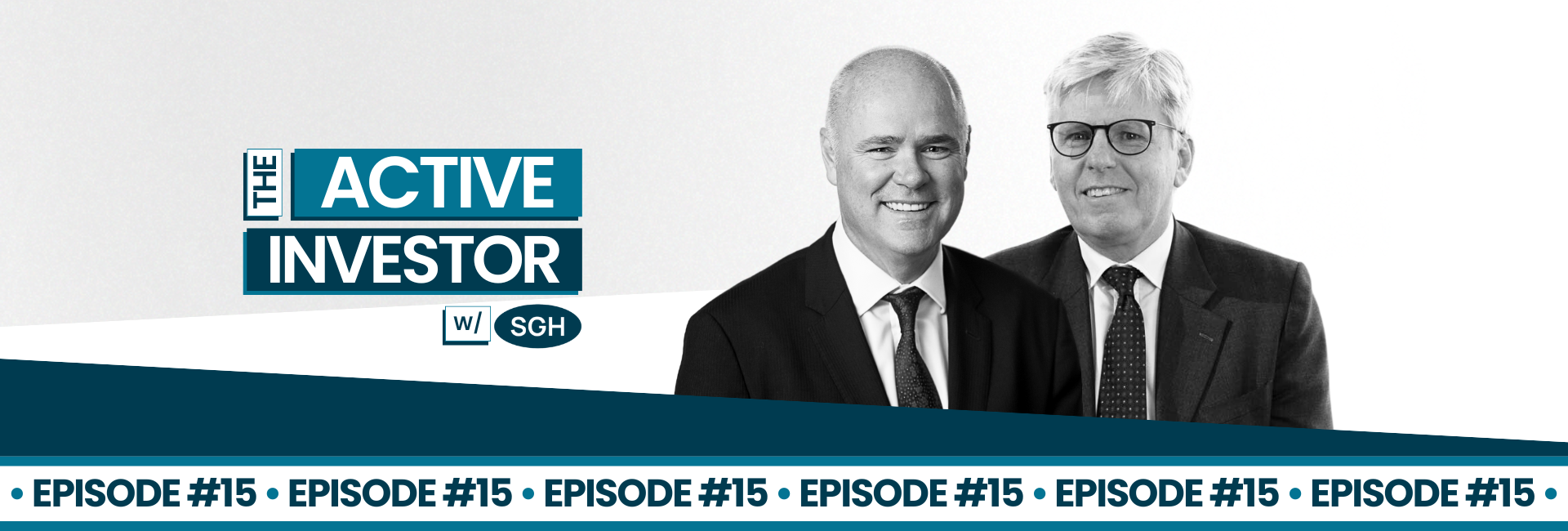
In episode #15 of The Active Investor with SGH â September 2025 reporting season rundown â Steve Hiscock is joined by Hamish Tadgell, Head of Australian Equities, to unpack one of the most volatile reporting seasons in memory. They examine record stock price movements, the outperformance of small caps, and the widening gap between defensive domestic franchises and globally exposed cyclicals. From CSL’s shock result to gold’s surge, NEXTDC’s strength, and a spotlight on banks, energy and REITs, the discussion highlights where earnings are holding up, where risks are building, and why selectivity is key for investors in a high-valuation market.
More places to find our podcast:
September 2025 reporting season rundown
Transcript:
Steve Hiscock:
Hello, and welcome to the next episode in our SGH podcast series, the Active Investor with SGH. My name is Steve Hiscock, executive chairman of SG Hiscock, and today we’re going to focus on the recent Australian August reporting season and delve into the results, key reflections and insights. Today I’m joined by Hamish Tadgell, head of Australian Equities and portfolio manager for the SGH High Conviction Fund. Welcome Hamish.
Hamish Tadgell:
Thanks, Steve. It’s great to be here.
Steve Hiscock:
Great to have you, Hamish. Today we are recording on the 4th of September, having just come through a reporting season, which I think has been described in a headline as a once-in-a-generation reporting season. Certainly one of the more interesting that I can remember, and certainly one of the most volatile, and that’s probably a good place to start.
Let’s start with the high-level takeaways that you’ve got from the reporting season.
Hamish Tadgell:
Sure, Steve. Look, I think it’s fair to say it’s been one of the most volatile and unusual reporting seasons I certainly remember, and we’ve seen some massive price moves. In fact, it’s been a record in terms of 46% of stocks saw price moves greater than 5% and almost a third, greater than 10%, which was particularly accentuated in the large caps. You’d normally expect to see that more in the small caps. Moves and stocks like CSL, AGL, Woolworths, James Hardie, and Amcor were just extreme to be frank. Another noticeable theme was that small caps were very strong performers, outperforming large caps by about 6.3% and the broader ASX 300 by over 5%.
And that was really led by very strong resources, particularly in the consumer discretionary and REIT sectors, among the small caps. Just on earnings, if you look at the aggregate earnings for financial year 25, they were downgraded by about 2% and ended up minus 5% for the year, and that’s the third straight year that we’ve seen earnings downgrades, or earnings falling, in the ASX. Overall, I’d characterise it as a very mixed reporting season where the market continues to reward companies that deliver with perceived dominant positions. Even where they’ve got lower growth, and you know, the misses were certainly punished.
Steve Hiscock:
Yeah. And we saw the punishment, as you say. The move in CSL, which was Australia’s largest company, to fall that much in one reporting day, is quite unprecedented. Thanks, that’s a great overview. Let’s drill down a bit further on that – the difference between large caps and small caps in terms of performance.
What do you think is driving bifurcation in stock performance? It’s not just large caps and small caps, but banks and healthcare stocks as well. Huge dispersion there. Can you talk to that?
Hamish Tadgell:
Yeah, sure. Look, I think there seems to be an increasing gulf in my view between the price and valuation investors are prepared to pay for businesses with a dominant, largely Australian domestic franchised and perceived defensive earnings versus those companies that rely more on economic dynamism or are more linked, I would say, to the underlying economy and with international exposures. Even if they’ve got stronger earnings growth, they seem to be penalised at the moment.
Clearly, that’s been most evident in the banks. You know, we’ve seen them very strongly before. They’ve almost been seen as safe-haven type stocks. Additionally, companies like Wesfarmers and JB Hi-Fi, which are strong domestic franchises, have probably maintained or even improved their dominant position over the last few years.
The market’s shown a real preparedness to pay ever higher prices for those earning streams. It seems irrespective of where valuations are. On the other hand, if you look at those stocks that are more linked to the economy and the international, and we particularly saw this through reporting season for the likes, as I’ve said, James Hardie, CSL, Reece, Amcor, all businesses that have strong positions in the US. The market is much more concerned about the underlying growth in these businesses, worried that it’s slowing, and concerned that higher regulation, inflation, and tariffs are impacting it, leading to higher costs of doing business and creating a much more complex and uncertain operating environment for those businesses.
So, I think that if anything, the differences through the reporting season have been accentuated in this.
Steve Hiscock:
Right.
Hamish Tadgell:
And, it’s a consistent theme we’ve seen now for some time.
Steve Hiscock:
I mean, you talked about CSL, James Hardie, Reece and Amcor. One of the things that they’ve all had in common is that they’ve recently had relatively large acquisitions. Sometimes, at the time, investors weren’t necessarily happy with all of them. But certainly, they’re the companies that have had interesting moves in the reporting season. Do you think the acquisitions themselves are part of the market’s concerns?
Hamish Tadgell:
Oh, look, I think it’s certainly a contributing factor, to varying degrees.
The track record of Aussie companies going offshore has not been great, and the markets tended to adopt a reasonably sceptical and cautious view around that. If we look through the reporting season and some of the commentary from companies, there’s certainly a discernible weakening in the US economy and more challenging trading conditions over there.
It’s clear that the US housing market activity, for both new builds and remodelling, is weighing on the likes of Reece and James Hardie. And the tariffs and policy uncertainty are also weighing on households and business confidence more generally.
Another thing that is clear is that cost-of-living pressures are causing consumers to trade down. That’s putting pressure on margins and companies’ abilities to push through prices. Lastly, and this was more evident in the Amcor result, there is some question as to whether companies have pulled the price lever too hard over the last few years as they’ve sought to offset inflation. And that’s now constraining their ability to pass on further cost and tariff increases and forcing them to look at lower margins, and that’s a concern that clearly the market’s starting to affect in some of the price moves.
Steve Hiscock:
Yeah. I suppose the only good thing is that inflation has come down. So, perhaps the pressure has come off a little bit. Let’s move on to small companies. So, they really did outperform the market during reporting season.
They underperformed a lot before that, the last few years. One thing we do know is that small and mid-cap top-cap stocks tend to perform significantly better when there are rising expectations of interest rate cuts and as the economy improves. Is that what we’re seeing? Is that why small companies are starting to outperform now?
Hamish Tadgell:
Yeah, look, that’s right. I think that it’s certainly a theme that played through the reporting season. Those catalysts that you’ve identified, they’re certainly resonating. If you look at the domestic leveraged retail and consumer companies’ results, there’s good evidence from them that they’re starting to see a stabilisation in consumer confidence.
Certainly an improvement post the May rate cuts, and it’s starting to feed through into that confidence. We also saw a number of retail REITs highlighting discernible sequential improvement month-on-month, from May to June and then into August.
Companies like Baby Bunting, AP Edgars, JB Hi-Fi, Coles, and some of the apparel companies are also highlighting similar trends. The other thing I’d say is that the other area where you’re seeing the market turn a bit is on the property side. So, the commentary out of the REITs was certainly better.
REITs were one of the best-performing sectors during the reporting season. Stockland, Mirvac, and Charter Hall are all highlighting increased property inquiry on the back of rate cuts. However, what we’re not yet seeing is the flow-through to activity. Therefore, it’s not yet translating into new starts, and consequently, it’s not yielding building materials. Companies like Reece, James Hardie, and Boral are not yet seeing the benefits.
But it will come, and I think the important thing to remember is that the market is forward-looking. And the market will price this in ahead of seeing it show up in the data.
Steve Hiscock:
Yeah, absolutely. You’ve talked about some positive signs in retail and the REIT sectors.
What were some of the other key surprises, upside or downside and takeaways from a sector and stock perspective, and how did the portfolio go? The high conviction portfolio?
Hamish Tadgell:
Reporting season really confirmed that Australia is better positioned from a relative perspective, from the geopolitical tariff and economic uncertainty we’re seeing under the Trump policy decisions, so I think Australia’s well-positioned. And that was clearly evident in more of the domestic cyclicals that outperformed the global cyclicals. I’ve discussed some of the difficulties James Hardie, Amcor, and others are facing, but companies like Cleanaway, Qube, Seven Group Holdings, and even some contracting service companies reported solid results. And we’ve got a number of those in the portfolio. They’re all highlighting the continuing expectation of good growth into the latter part of 2026.
The other key theme I would highlight is that many digital and social infrastructure and service businesses perform well. So, NEXTDC and Chorus are two stocks we have in the portfolio. Both had really good results. NEXTDC was probably one of the standout results for us this reporting season. It’s just highlighting that NEXTDC is an Australian data centre player, looking to expand into Asia. They had really strong demand in their data centres with contracted utilisation up over 40% year-on-year. And, the other thing is that they’ve announced some big steps in terms of improving the balance sheet and the way that they’re funding some of these expansions.
Interestingly, with their Japanese expansion, they’re doing a JV with CBRE and a number of the institutional funds, which is alleviating potentially the need to raise more capital, which has been one of the market’s concerns around that stock. But overall, those two results were really good and good contributors to the portfolio.
Steve Hiscock:
NEXTDC, most people will be familiar with, but Chorus is a New Zealand company, so it might be worth just talking about what it does.
Hamish Tadgell:
Chorus is effectively the NBN in New Zealand; it’s a monopoly, and it provides the fibre network in New Zealand. It’s finished building that network out over the last couple of years, and really, I guess it’s going from a construction to an operating mode, and we’re now starting to see free cash flow come through. And with that, the company’s really upped the dividend. So, it’s really a yield stock, if you like. It has a yield of about 6%, or was 6.5%; it’s probably closer to 6% now. And, we like it because of that defensive characteristic, strong dividend growth, and strong cash flow generation.
Steve Hiscock:
Great. And it’s certainly done very well. Well done on those two stocks. Let’s talk about CSL. Everyone knows CSL. It was a huge, I guess, one of probably the biggest surprises coming out of the reporting season.
16% down on the day it reported. It hasn’t really recovered. It’s a holding that our portfolio has had for some time; it’s a portfolio holding for many fund managers and many individuals. How are you seeing CSL now? How does it look going forward?
Hamish Tadgell:
Yeah, look, you can only characterise the result as disappointing, relative to expectations.
And it wasn’t so much the result itself. The 2025 numbers actually came in as a slight beat. We can debate the quality of that. Some would argue that low R&D and tax helped a little bit get there. But the big surprise was the soft guidance around their Behring plasma business.
So their core business in 2026, and they’ve been on a path of COVID recovery and getting back to the Behring margin of pre-COVID levels by 2028. And what they said was that they’re still confident in getting back to that margin, but it’s going to take longer. And so, effectively, if you like, maybe walked away or extended that guidance outlook.
Another thing that shocked the market was the announcement of several major restructuring initiatives. So, they’re going to undertake a $500 million-plus cost-out. They’re going to change the way that they do their R&D. So, they’re going to use a bit more buy-in projects when they’re further advanced, rather than organic.
Not all of them, but some of them. They also announced the plans to demerge their Seqirus flu business. And I think the market’s questioning that and saying: Why are you doing it? How’s that going to create value for shareholders? And that, coupled with the queries around the guidance on Behring, has got the market raising more questions than answers around the competitive dynamics and the recovery in that plasma business.
If we look at it fundamentally, we think the share price move looks overdone. There’s a lot factored in, but I guess, as we know, without the catalysts or without further demonstration and evidence from this management team – and it’s also important to recognise it’s a relatively new management team still, and the market’s still building confidence in them – that it’s going to take a bit of time and further evidence, so our weight has lightened off a little bit. It still is a core holding. And we still think over the medium and longer term, this is a high-quality business with a strong competitive advantage, where we see returns improving.
That is a catalyst for share price re-rating in the longer term.
Steve Hiscock:
Yeah, look, it’s one of Australia’s success stories, so just on Seqirus, it’s a pretty big part of the business, isn’t it?
Hamish Tadgell:
It’s about a third, 25% to a third. And remember, it’s essential to acknowledge that this is a business they acquired from Novartis almost a decade ago. It was loss-making, right?
The business now makes a billion dollars in EBIT.
Steve Hiscock:
Right.
Hamish Tadgell:
And 65% margins.
Steve Hiscock:
Okay.
Hamish Tadgell:
And so, it is a business that they’ve really turned around. I guess to some degree, the market is questioning why spinning it out, given it’s such a profitable business. But I think it’s about trying to simplify and get more clarity.
And the bearing business end of today is a business that should trade on a much higher rating than it is at the moment. And I guess the question is, how do you achieve that?
Steve Hiscock:
And certainly a spin-out might do the trick there. And because it’s a spin-out, it may be tax-effective.
Hamish Tadgell:
They’re saying that it will have rollover relief.
Steve Hiscock:
Okay. Great. Let’s talk about the bank results. I guess several of the bank results were a little bit disappointing. We saw a flight to safety, and the banks were again big winners through the reporting season, with all major banks reporting gains. Can you make sense of all that?
I mean, what did you make of the bank results? How are we positioned?
Hamish Tadgell:
I would describe the bank results, remembering that they’re not all full-year results, as some of the trading updates are quarterly. I’d say they came in broadly in line, or maybe a touch better overall.
But the key here is that, and when I say touch better, probably two or 3% better. But I think the results were really well received. Because, in part, what you’re seeing is a rotation out of some of the big-cap disappointments into the banks, which, as I said before, are being perceived as a bit of a safe haven at the moment. I guess the broader point I’d make on the banks is that it’s really hard to argue at the moment that there’s much value in the banks where they’re trading, and particularly on the earnings outlook, which 26 is essentially flat for most of the banks.
But the market, as I said, seems to be prepared to hold the banks at the moment and put more money to work here as defensive safe havens. And I think that’s really a function of that, that bad debts remain pretty low, that the Australian economy and macro remain pretty supportive.
From our perspective, we’re underweight in the banks quite considerably, and our preference is certainly for ANZ at the moment. And that’s because we see an opportunity for a re-rating. It has underperformed the other banks and has a new CEO. Nuno Matos has come in. And he is going to, and over the next month or so, set a new strategic target in terms of costs and returns.
Our feeling is that that’ll get the market more excited about this. And, we think there’s a good ability for the bank to re-rate from here.
Steve Hiscock:
Alright, let’s talk energy. It’s been one of the best-performing sectors over the last quarter and has obviously been helped by the bid for Santos by XRG.
It’s had a pretty tough 12 months on the geopolitical and domestic policy front. In terms of the reporting season, what can we take from it for the energy sector, and how are you positioned in energy stocks?
Hamish Tadgell:
First, Steve, I want to say that we’re still quite bullish about the energy transition.
We think it’s an undeniable trend. We think that gas is a very important part of the transition and provides base load capacity, here in Australia. Another important point to note is that since the May federal government election, we have seen a significantly more constructive policy stance, and some of the larger projects that were being delayed have actually received approval.
And to your point that you’ve raised, the Santos bid has shone the light back on Australian gas assets and highlighted that we’ve got some really good quality assets here that have scale in a good jurisdiction. And more to the point, we’ve got the LNG exports, but also they are a big part of the solution for the emerging problem around the East Coast gas shortage that we’re seeing, particularly in Victoria, as we turn coal off.
So, Amplitude and Beach Energy are two positions we’ve got in the portfolio. The results really confirmed the trends I’ve been talking about. Importantly for us, though, they both highlighted that over the next 12 – 18 months, we are going to see better free cash flow generation out of these businesses.
And both companies are entering into some drilling activity. We’re reasonably confident that we’re going to see some success on those drilling campaigns and upgrades to resources. The other stock we do have, which is not so much a gas play, is Worley; it is probably one of the better results through the reporting season.
Worley has really underperformed over the last 12 months. It’s a global energy and chemicals consulting business. It does a lot of work in the US but also in the Middle East and all around the world. And it’s seen a strong pickup in renewable and sustainable work.
It’s also seeing a benefit of a lot of the investment that’s going on in the US in terms of hydrogen and some of these other projects. Its result was good, and importantly, it even upgraded its margin guidance to 26%, which has given the market a lot more confidence around the numbers.
Steve Hiscock:
Okay. Look, Woodside hasn’t been a great performer. What are your thoughts? I mean, it’s a big stock, right?
Hamish Tadgell:
Yeah. So Woodside is going through a very heavy CapEx phase at the moment. And it’s clearly benefiting from higher oil prices. But our preference at the moment is for Santos.
So we’ve been positioned in Santos, over Woodside. We did that switch probably about four or five months ago, ahead of the bid, which was good. But I guess it’s just a relative performance in a concentrated portfolio, and you’ve gotta pick your bets.
Steve Hiscock:
I mean, that’s the thing. You’ve got a high conviction fund. You can’t own everything. So. You’ve gotta go with what you think is going to do best. Okay. Let’s talk about the resources sector more generally. It was a real highlight, a great performance during August – very strong performance, particularly from gold and gold stocks.
Gold stocks are up 20% in the month, perhaps driven by expectations, US rate cuts, macro issues, and Donald Trump; who knows? But what’s your current positioning in gold, and how are you seeing it?
Hamish Tadgell:
So gold, yeah, you’re right, certainly got people’s attention at the moment. Yeah, and the increased expectation of US rate cuts has certainly been a driver in the breakout in the gold price we’ve seen recently. It’s also being driven, though, by concerns around US Fed independence and US debt and dollar concerns. And so more macro-driven than fundamentally driven. The gold price has just hit US$3,500 an ounce.
That’s about 5,400 Aussie dollars an ounce, and at that price, domestic gold producers are making a really good margin. And that’s also helped offset maybe some of the concerns that came through in the June quarterlies around higher, all-in sustaining costs for the gold producers and higher CapEx numbers.
We continue to have really good exposure to gold. So we’ve got about 9% of the portfolio in gold at the moment, mainly through Northern Star and Genesis Minerals. Both of which we see as having really strong growth opportunities over the coming years, and effectively providing a hedge against macro uncertainty in the portfolio.
Steve Hiscock:
And they’re sort of on the mid-cap side, aren’t they?
Northern Star’s in the 100 now. Right.
Hamish Tadgell:
Genesis is on the cusp of going into the 100. But Genesis is a stock that we’ve held for about two years now.
And we really like the management team there. It’s the same management team that used to run Saracen, and that’s a stock that we used to own in the portfolio, probably four or five years ago, where we made a lot of money as well. So, the key to gold stocks is finding stocks that are low on the cost curve with good organic growth, with management that you can back really.
Steve Hiscock:
Hamish, thank you. We’ve covered a lot of ground. Given you cover 300 stocks, you’ve done incredibly well to do it in that time. It’s obviously been a very eventful reporting season. The portfolio, more importantly, seems to have navigated it really well.
Look, in closing, what’s the outlook for earnings and positioning for you guys over the next 12 months or so?
Hamish Tadgell:
Yeah, good question, Steve. The earnings growth, if you look at the consensus coming out of reporting season, for the next 12 months, so financial year 2026, is about 2%. So, at the headline level, it’s hard to get excited. And if you look at the market multiple, specifically the PE 12 months forward, the price-earnings ratio 12 months forward, it’s at 20.3 times for the ASX 200. So that’s a 26% premium to its 10-year average. And, as we’ve seen in the last few reporting seasons, as earnings have come down, the PE has gone up with the market, so we’ve seen this continuous earnings expansion.
So, valuations are pretty elevated at an aggregate level, and with very benign earnings growth, what it implies is obviously lower returns. But that said, in this environment, I think we are still seeing really fertile ground for good alpha generation. And that’s because, as we’ve discussed, the bifurcation between stocks and the spread between winners and losers is widening at the moment. It’s about picking the right stocks rather than picking the index.
And what we’re trying to do in the strategy and the high conviction portfolio more broadly in all the strategies we run at SGH around being high conviction investors. That really necessitates the need to focus on the fundamentals, focus on quality businesses, which are leveraged to the things which we’ve spoken about, like AI and digital innovation, energy, critical infrastructure, and services, et cetera, right across the market spectrum, so across small-caps and large-caps.
Because, as we saw through reporting season, small-caps perform really well, and if we’re right, they’re going to continue to get interest rate cuts. The domestic economy’s going to continue and improve. And that probably lends itself more towards those mid-small cap exposures, where we are looking to add to the portfolio out of reporting season.
Steve Hiscock:
And what a reporting season it’s been.
Hamish, thank you very much for your insights there. You’ve done really well in the current, incredibly volatile environment. You’ve given us a lot to think about. There’s certainly a great deal of uncertainty given what’s going on in the world currently. But as you say, focusing on the fundamentals, investing in quality businesses at the right price, at sensible valuations anyway, is probably even more important than ever at the moment in the current environment.
Hamish Tadgell:
Thank you for coming today and giving us your views. Thanks, Steve. I really enjoyed the opportunity to have the conversation.
Steve Hiscock:
We hope you enjoyed today’s episode.
Follow us on LinkedIn, YouTube, Spotify, Apple, or wherever you get your podcasts from.
Please let us know if you have any questions or comments. Until next time, stay informed and stay active.
___
Disclaimer:
This podcast is produced by SG Hiscock and Company. It does not constitute financial advice and assumes a certain level of knowledge. It’s general information only and does not take into account the investment objectives, financial situation, or needs of any person and should not be considered a recommendation. For more information, visit: https://sghiscock.com.au/podcast-disclosures-and-disclaimers/.

Stay in the loop
Get the latest insights and company news direct to your inbox.
SG Hiscock & Company (SGH) has prepared this article for general information purposes only. It does not contain investment recommendations nor provide investment advice. Neither SGH nor its related entities, directors or officers guarantee the performance of the Funds. SGH also doesn’t guarantee the repayment of capital or income invested in the Funds. Past performance is not necessarily indicative of future performance. Professional investment advice can help you determine your risk tolerance as well as your need to attain a particular return on your investment. We strongly encourage you to obtain detailed professional advice. We recommend that you read the relevant Product Disclosure Statement and Target Market Determination, if appropriate, in full before making an investment decision.SGH publishes information on this platform that is, to the best of its knowledge, current at the time of publication. It is not liable for any direct or indirect losses attributable to omissions, outdated, inaccurate, incomplete or deficient information. Investors and their advisers should make their own enquiries before making investment decisions.