
SGH High Conviction Fund update – Q1 2025
In this SGH High Conviction Fund update, Hamish Tadgell and Mike Kordick unpack Q1 2025 performance, reporting season takeaways, and the key themes shaping portfolio positioning.
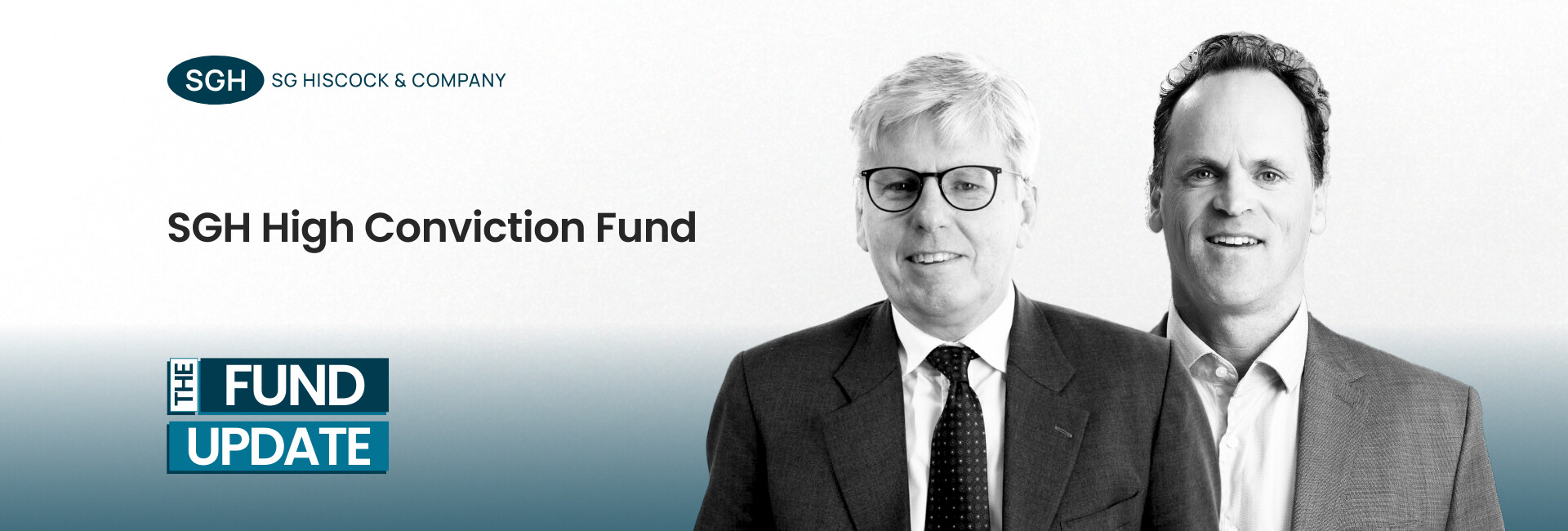
In this SGH High Conviction Fund update, Hamish Tadgell and Mike Kordick provide a detailed overview of the fund’s performance for the March 2025 quarter. They discuss portfolio positioning during a volatile reporting season, key contributors like Generation Development Group and Amplitude Energy, sector-level themes in REITs and banks, and where they’re seeing opportunities in infrastructure, essential services, and gold.
Transcript
Hamish Tadgell:
Welcome to the March quarterly update for the SGH High Conviction Fund. I am Hamish Tadgell, Head of Australian Equities and portfolio manager for the fund. As a reminder, the High Conviction Fund is an actively managed portfolio of up to 25 to 30 stocks that seeks to take a longer-term view, invest in quality companies, and exploit market inefficiencies with a strong focus on valuation. Today, I’m joined by Mike Kordick.
Mike Kordick:
Thanks, Hamish. It’s good to be here.
Hamish Tadgell:
It’s been an interesting start to the year, dominated by big macro policy swings triggered by Trump and his tariff announcements, the RBA’s commencement of the rate-cutting cycle in February, and the domestic reporting season.
We’ve also seen much uncertainty in markets, which have been very volatile. During the month, the ASX 300 accumulation index was down 3.3% but better than the S&P 500, which was down close to 6%. Importantly, the fund outperformed during that period, returning about minus 1.9 per cent, about 1% ahead of the market.
Mike, could you give us more information on how the portfolio performed during the quarter?
Mike Kordick:
Thanks, Hamish. Certainly can. We were pleased with how the portfolio performed through the reporting season, outperforming the benchmark with no significant surprises. Reporting season is always a good opportunity to verify our investment thesis, and we didn’t make many changes to the portfolio. We saw strong results in several stocks – Generation Development Group, Amplitude Energy, and Worley Limited. Generation Development Group is a financial platform provider that also owns an investment bonds business. The stock price rallied strongly with a better-than-expected update and had positive net flows or inflows supported by growth in its managed accounts business.
We continue to see that this business is very scalable, with structural growth in the managed account business and investment bonds. We think this will be complemented with further accretive M&A. If we touch on some of the energy providers, Amplitude Energy and Worley Limited, both contributed strongly after reporting good results, highlighting the good operating momentum and free cash flow generation of these respective businesses.
That provided some relief from the macro uncertainty around energy policy, which is impacting some of their share prices. Amplitude – that uncertainty came through with the East Coast Gas Policy and Worley Limited around the potential changes to the Inflation Reduction Act funding and the US LNG projects, where Worley Limited has significant exposure.
Now, Hamish, I can pass this on to you, and you can comment on what you thought happened during the reporting period. Are there any changes?
Hamish Tadgell:
One of the key trends we saw in the reporting season was in the REIT sector. It began to emerge last August, but now we’re starting to see some bottoming in the property market. We’re seeing increasing transaction evidence, which has been very supportive of book values. Investors – largely absent for years – seem to be returning to the market.
Over the last few years, REITs have been upgrading their portfolios and removing some non-core assets. So you’ve had this situation where most of the portfolios across the REIT sector have seen an upgrade. They’ve got rid of underperforming assets, and we’ve seen a recalibration of the assets, which means we’re starting to see better rental growth. Another encouraging trend is the gradual improvement in the office market. There’s still a way to go, so we remain cautious, but signs suggest the cycle is turning, and offices are becoming more attractive. That said, we still prefer retail at this stage of the cycle. We recently took a position in Vicinity. Vicinity owns the Gandel Shopping Centre and several other very high-quality shopping centres, which are hard to replicate and continue to benefit from a supply shortage, so they are still getting strong positive net rental growth.
The other thing we’ve done is we’ve added Summerset to the portfolio.
So it’s a New Zealand retirement REIT. It’s not, per se, a REIT that you think about most strictly, but it’s very leveraged to the property market. We see it’s also got a strong business in New Zealand. Now that the market is starting to turn, we see 175 basis points of rate cuts in New Zealand, and we think that Summerset is very well leveraged to that.
Mike Kordick:
The performance of banks was interesting throughout reporting season. Obviously, they’ve had significant performance in the last calendar year; however, during the reporting season, they were relatively underperformers. Could you comment on the bank results to see if there are any cracks and where your updated thinking is?
Hamish Tadgell:
Yeah, it’s a good point, Mike. And it certainly was a big focus through reporting season. As you say, we came into reporting season with banks and have had an incredibly strong year. And looking, I think, expensive on any measure. They’re trading four standard deviations above their historical long-term average, or at least CBA has been. During reporting season, we saw several trading updates and a bit of weakness in the results. I think it caught the market more broadly by surprise. Just the extent of that, particularly the Bendigo result and against the NAB result. So what did we see? We saw a few cracks starting to open up.
There’s nothing that makes us think that there’s an imminent downturn, but the numbers just aren’t as crisp as what they’ve been reporting over the last little while. So we saw NAB, particularly its Net Interest Margin, come down. We saw bad and doubtful debts tick up a little bit.
We saw mortgage deferrals, particularly when they called out Victoria, which many companies called out as very soft through reporting season. It’s essential to put this in context. The quarterly results can be noisy.
What we are seeing is that the cycle has probably turned or at least peaked. We think it’s perhaps hard to see how the banks continue to rerate from here, so we’re more cautious. We’ve been selling some of the banks, and we are significantly underweight or materially underweight with the banks. We’ve got about 7% in the banks as we speak. And I think it’s an area that we continue to watch and probably a funding area for us as we look for other opportunities.
Mike, let’s talk about Light and Wonder, a stock we added to the portfolio during the reporting season.
Mike Kordick:
Light and Wonder, which we recently added to the portfolio, is a global leader in electronic gaming machines and gaming content. The stock is not without issues- a competitor has filed a current litigation case against it. However, the underlying fundamentals are solid, and it’s had a really strong game performance.
It’s the number two operator in the industry, and the top two operators are ahead of the rest of the pack. The company has an experienced management team. About a decade ago, the management team transformed Aristocrat into a global leader, and right now, the company is well positioned for growth.
It’s trading on less than 14 times, and you’re getting a 30% growth rate over the next 12 months. The EPS compound growth rate will be in the range of 20% for the next few years, so it is attractive to us.
Hamish Tadgell:
It’s interesting, Mike. It’s a stock that fits our fundamental process of looking for quality companies with strong growth and attractive valuation.
As I highlighted at the outset, there’s been much uncertainty in markets and volatility driven by the macro. That’s creating opportunities. Could you give us a bit more colour about how we’re thinking about positioning in the current environment and some of the themes that are running through the portfolio?
Mike Kordick:
The market is very unpredictable, warranting a cautious approach. We’ve increased the defensiveness in our portfolio, but we still see opportunities in companies with strong prospects, good growth rates, and attractive valuations.
Key themes include critical infrastructure, essential services, and the gold sector. In infrastructure, we favour Chorus and Infratil, which have monopolies or regulated assets with significant entry barriers. Chorus, a wholesale internet provider to most New Zealanders, has limited competition and benefits from increased data demand and market penetration. It’s also inflation-hedged with CPI-linked pricing and has significant growth in free cash flow as it moves from the construction phase into the operating phase. And we’ve seen a growth in dividends as well. Interestingly, last August, they increased their dividend by 20%.
Mike Kordick:
That said, the stock’s trading about a dollar or 10 to 15% lower than those levels at the time, and it’s currently yielding a 7% dividend yield, which is attractive. Infratil owns many defensive and infrastructure-like assets across digital, renewables, and the healthcare sector, including Canberra Data Centres, Longroad Energy and One New Zealand (formerly Vodafone). So, this is another company expected to provide defensiveness and earnings growth through these times. In essential services, Cleanaway stands out. Cleanaway is a market-leading waste management company with a strategic footprint of landfills and transfer stations. Also, we see it with favourable regulatory and industry tailwinds. The stock’s attractively priced; it’s got a PEG ratio of 1x, with compound earnings growth in the low 20s and a PE around the same – well-positioned for the next few years.
Lastly, the gold sector—gold is a valuable diversifier, providing hedging against geopolitical risk, inflation, and potential US dollar weakness. In this sector, we own Genesis Minerals and Northern Star. Genesis is a mid-cap gold miner consolidated in the Leonora gold mining region, has a competent management team we know well from Saracen and is targeting really strong production growth, doubling over the next couple of years to 300,000 ounces or more and reducing production costs. Northern Star is a large-cap gold miner with tier-one assets, substantial gold reserves, and low production costs.
Hamish Tadgell:
Thanks, Mike. Look, that’s been a great insight into the portfolio, highlighting the different sources of opportunity we’re currently seeing. The idea in building the portfolio is clearly to get diversification across the life cycle so that we’ve got different drivers from different stocks helping deliver performance, and with that, really trying to provide downside protection in uncertain times, like it is at the moment, that’s important. The portfolio has had a very strong track record of doing that in the past, outperforming about 90 times per cent of the time in down markets.
In closing, I’d like to remind investors that the High Conviction Fund is a concentrated portfolio of 25 to 30 stocks. And we think it is a strategy that is ripe for the times, with the high level of uncertainty we’re currently seeing in the markets. The focus on quality stocks and valuation means that it builds resilience into the portfolio. And as we’ve discussed, we see many good opportunities where we think that there is a latent value that we’re looking to capitalize on over the next few years and beyond. So, thank you for joining us, and we look forward to the next update in June.
*The text has been edited for clarity.
For more information about the SGH High Conviction Fund, click HERE.
Disclaimer:
The document contains general information only. Reference to either individual securities or other investments should not be considered as investment advice. We strongly encourage you to obtain professional advice before making an investment in securities that have been mentioned. Documents you should consider prior to making an investment could include the relevant Product Disclosure Statement and the accompanying Target Market Determination. If you would like further information on financial products that SG Hiscock & Company Ltd (AFSL 240679) is the investment manager for, contact the Client Services team on 1300 133 451, visit the website www.sghiscock.com.au or contact your financial adviser. Any investment is subject to risk, including possible loss of income or capital invested.

Stay in the loop
Get the latest insights and company news direct to your inbox.
SG Hiscock & Company (SGH) has prepared this article for general information purposes only. It does not contain investment recommendations nor provide investment advice. Neither SGH nor its related entities, directors or officers guarantee the performance of the Funds. SGH also doesn’t guarantee the repayment of capital or income invested in the Funds. Past performance is not necessarily indicative of future performance. Professional investment advice can help you determine your risk tolerance as well as your need to attain a particular return on your investment. We strongly encourage you to obtain detailed professional advice. We recommend that you read the relevant Product Disclosure Statement and Target Market Determination, if appropriate, in full before making an investment decision.SGH publishes information on this platform that is, to the best of its knowledge, current at the time of publication. It is not liable for any direct or indirect losses attributable to omissions, outdated, inaccurate, incomplete or deficient information. Investors and their advisers should make their own enquiries before making investment decisions.